The use of small-scale energy storage systems (ESS), such as home batteries, is rapidly increasing in the residential market. Although lithium-ion batteries have a relatively low failure rate, incidents can lead to severe consequences due to thermal runaway, smoke development, and prolonged fire processes. The Netherlands Institute for Public Safety (NIPV) describes in the report ‘Incident Response for Home Batteries’ (2026) the risks and key considerations for emergency services and building safety. In this article, we show how the Batteryshelter can be applied as an effective technical solution to mitigate these risks.
Risks according to the NIPV
The NIPV states that lithium-ion batteries can develop thermal runaway in case of failure, resulting in extremely high temperatures and long-lasting fires. In addition, toxic and corrosive gases such as hydrogen fluoride (HF) may be released, and fire spread to surrounding structures can occur. Battery fires also pose risks to emergency services due to re-ignition and prolonged system instability.
Positioning of the Batteryshelter
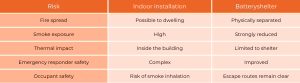
The Batteryshelter is an external, fire-resistant enclosure for EOS systems. This solution addresses the risks identified by the NIPV by physically separating the system from the building, limiting smoke and gas exposure, protecting against thermal radiation, and improving the operational effectiveness of emergency services. External placement ensures that escape routes remain free from smoke and heat, significantly enhancing evacuation safety.
Technically substantiated based on risks
Lithium-ion batteries are characterised by a relatively low probability of failure, but a potentially high impact in case of incidents. According to risk management principles, limiting consequences is an effective strategy for risk control. A Batteryshelter reduces the impact of incidents by limiting fire spread, minimising smoke exposure, and improving the safety of occupants and emergency responders.
Based on the NIPV report, it can be concluded that the main risks associated with home batteries relate to thermal runaway, smoke development, fire spread, and emergency response challenges. The application of a Batteryshelter provides an effective and proportionate technical measure to mitigate these risks and contributes to the safe integration of small-scale energy storage systems within the built environment.
Source: Nederlands instituut publieke veiligheid